Showing posts with label ecology. Show all posts

Monday, May 27, 2024

491 - Less Liquid Lands Losing Lichens

Lichens on rock By Jesse Noar CC BY 4.0
This episode: Trends of declining lichen populations and biocrust cover overall match trends of increasing temperatures in Colorado dryland!
Download Episode (6.4 MB, 9.3 minutes)

Show notes:

Microbe of the episode: Cherry chlorotic rusty spot associated partitivirus

Takeaways:


Global climate change is affecting almost every natural system on the planet, in predictable and also sometimes unexpected, complex ways. Microbes perform key roles in many different ecosystems, providing and recycling important nutrients and even macroscopic structure. One example of this is biocrusts in dryland environments, such as areas in the western US with low annual rainfall. Microbes other organisms form a stable surface binding soil and sand particles together, helping to retain moisture and prevent erosion and transformation of land into desert.

In this study of a Colorado park over more than 20 years, important species of symbiotic fungi and photosynthetic microbes in the form of lichens have declined significantly. The land is mostly untroubled by grazing or human activity, but changes in climate and moisture and the presence of invasive plants could affect lichens. However, the temperature increase over the decades showed the best correlation with the lichen decline. The loss of these species could lead to nutrient shortages in the long term for these communities.

Journal Paper:

Finger-Higgens R, Duniway MC, Fick S, Geiger EL, Hoover DL, Pfennigwerth AA, Van Scoyoc MW, Belnap J. 2022. Decline in biological soil crust N-fixing lichens linked to increasing summertime temperatures. Proc Natl Acad Sci USA 119:e2120975119.


Post questions or comments here or email to bacteriofiles@gmail.com. Thanks for listening!

Subscribe: Apple Podcasts, Google Podcasts, Android, or RSS. Support the show at Patreon, or check out the show at Twitter or Facebook.

Monday, January 29, 2024

489 - Soil Smell Synthesis Significance

C. elegans nematode
By Bob Goldstein
UNC Chapel Hill
CC BY-SA 3.0
This episode: Many organisms produce the smell of earth, geosmin, and many others can sense it–but why?
Download Episode (6.0 MB, 8.7 minutes)

Show notes:
Microbe of the episode: Acidianus spindle-shaped virus 1
 
 
Takeaways
The smell of soil or earth is one of the most recognizable smells, and comes largely from a chemical called geosmin, produced by many different kinds of bacteria. Many animal species are sensitive to geosmin, some attracted by it and others repelled. But it is still not entirely understood what is the evolutionary benefit to the microbes that produce it, or the reason why different animals are sensitive to it in different ways.

In this study, different geosmin-producing bacteria were paired with tiny bacteria-eating roundworms, nematodes, to see how the chemical affected their interactions. Production of geosmin affected the worms' movement, apparently inducing them to avoid colonies of the producing microbes in some cases, though the worms still sometimes fed on the bacteria. Adding geosmin to colonies of different bacteria did not affect the worms' behavior though, so other factors seem to be involved.


Journal Paper:

Zaroubi L, Ozugergin I, Mastronardi K, Imfeld A, Law C, Gélinas Y, Piekny A, Findlay BL. 2022. The Ubiquitous Soil Terpene Geosmin Acts as a Warning Chemical. Appl Environ Microbiol 88:e00093-22.


Post questions or comments here or email to bacteriofiles@gmail.com. Thanks for listening!

Subscribe: Apple Podcasts, Google Podcasts, Android, or RSS. Support the show at Patreon, or check out the show at Twitter or Facebook.

Monday, December 11, 2023

488 - Social Slimes Synchronize Sorties

Fonticula alba
By Toret et al. 2022
Curr Biol 32:1962
CC BY 4.0

This episode: Slime mold amoebas Fonticula alba have interesting and unique foraging and reproductive behaviors!
Download Episode (7.3 MB, 10.6 minutes)

Show notes:
Microbe of the episode: Cajanus cajan Panzee virus

 
Takeaways
How did life develop from single-celled organisms acting independently into the complex, multicellular organisms we see and are today? Although it is difficult to look back through time to study how ancient organisms may have developed along this path, it is possible to investigate modern organisms that occupy a zone in between single-celled and multicellular, to see if we can get some hints to our own development, and also learn about some interesting microbes along the way!

This study into the social amoeba, or slime mold, Fonticula alba, finds that the individual amoebal cells in a population join together into collectives and break apart into individuals at different stages of their complex life cycle, depending on the status of the bacteria around them that they forage as prey. The investigators tease out the various pathways taken by these amoebas.

Journal Paper:

Toret C, Picco A, Boiero-Sanders M, Michelot A, Kaksonen M. 2022. The cellular slime mold Fonticula alba forms a dynamic, multicellular collective while feeding on bacteria. Curr Biol 32:1961-1973.e4.


Post questions or comments here or email to bacteriofiles@gmail.com. Thanks for listening!

Subscribe: Apple Podcasts, Google Podcasts, Android, or RSS. Support the show at Patreon, or check out the show at Twitter or Facebook.

Monday, November 20, 2023

487 - Probiotic Pulverizes Pathogen Persisters

E. coli
This episode: A probiotic strain of E. coli can target and destroy pathogens that survive a treatment of antibiotics!
Download Episode (8.2 MB, 12 minutes)

Show notes:
Microbe of the episode: Streptomyces griseoruber
 
Takeaways
Antibiotic resistance is becoming more and more of a problem as bacterial pathogens develop resistance to more and more drugs. For some people who develop an infection that is resistant to everything, it's as if they were living back in the days before antibiotics were discovered, when all they could do was pray for survival. New antibiotics are needed, but even more needed are new ways of approaching treatment of infections, using innovative approaches and combinations of therapeutics.

In this study, a probiotic strain of Escherichia coli was used to target potentially pathogenic E. coli bacteria that can survive treatment with a particularly effective type of antibiotic, fluoroquinolones. This probiotic strain, called Nissle, delivers toxins directly to the survivors, preventing resistant pathogens from proliferating.


Journal Paper:
Hare PJ, Englander HE, Mok WWK. 2022. Probiotic Escherichia coli Nissle 1917 inhibits bacterial persisters that survive fluoroquinolone treatment. J Appl Microbiol 132:4020–4032.


Post questions or comments here or email to bacteriofiles@gmail.com. Thanks for listening!

Subscribe: Apple Podcasts, Google Podcasts, Android, or RSS. Support the show at Patreon, or check out the show at Twitter or Facebook.

Monday, October 16, 2023

485 - Small Cell Sculpts Sticky Snot Sphere

Mucosphere with captured prey
Larsson et al. 2022.
Nat Commun 13:1301
CC BY 4.0
This episode: A marine protist predator traps prey microbes in an attractive bubble of mucus, eats what it wants, and lets the rest sink, possibly sequestering significant amounts of carbon!
Download Episode (7.8 MB, 11.4 minutes)

Show notes:
Microbe of the episode: Bat associated cyclovirus 1

News item

Takeaways
The oceans have a lot of unique, unexplored life in them. This is true on a macro level but even more on a microscopic level, with many different kinds of microbes of various groups with fascinating life strategies. And despite being microscopic, with enough of them around, they can affect the whole planet's climate in significant ways.

In this study, one protist species gets most of its nutrients from photosynthesis, but what it can't get from the sun, it takes from prey microbes by force. To catch its prey, it creates an intricate bubble of mucus called a mucosphere, and waits for other microbes to swim into it, thinking it is food, and get stuck. Then the predator chooses the prey cell it wants and abandons the rest, letting them sink to the ocean floor and locking away the carbon they contain in the process.

Journal Paper:
Larsson ME, Bramucci AR, Collins S, Hallegraeff G, Kahlke T, Raina J-B, Seymour JR, Doblin MA. 2022. Mucospheres produced by a mixotrophic protist impact ocean carbon cycling. Nat Commun 13:1301.

Post questions or comments here or email to bacteriofiles@gmail.com. Thanks for listening!

Subscribe: Apple Podcasts, Google Podcasts, Android, or RSS. Support the show at Patreon, or check out the show at Twitter or Facebook.

Monday, September 4, 2023

482 - Colony Concentric Clock Construction

Bacillus subtilis
By Y tambe,
CC BY-SA 3.0
This episode: Single-celled bacteria can act independently to create patterns and structure in their biofilm communities!
Download Episode (9.6 MB, 14.0 minutes)

Show notes:
Microbe of the episode: Dictyostelium discoideum Skipper virus

News item

Takeaways
Large multicellular organisms like us have interesting mechanisms for using one set of genetic instructions present in all cells to form a large, complex community of many different types of cells with different structures and functions, all working together. Single-celled microbes do not have the same requirements for genetic or structural complexity, but they do often display interesting communal patterns and behaviors.

In this study, bacteria growing in colonies on agar displayed a particular mechanism of pattern formation previously seen only in eukaryotes, called segmentation clock or clock and wavefront process. In this process, the cells in the colony are all acting individually without communication with each other, but nevertheless form a repeating ring structure in the colony as it grows, possibly allowing some measure of differentiation of cells that could help the community survive various challenges.

Journal Paper:
Chou K-T, Lee DD, Chiou J, Galera-Laporta L, Ly S, Garcia-Ojalvo J, Süel GM. 2022. A segmentation clock patterns cellular differentiation in a bacterial biofilm. Cell 185:145-157.e13.

Post questions or comments here or email to bacteriofiles@gmail.com. Thanks for listening!

Subscribe: Apple Podcasts, Google Podcasts, Android, or RSS. Support the show at Patreon, or check out the show at Twitter or Facebook.

Monday, July 3, 2023

480 - Bait Bottlenecks Bear Bacteria

Black bear
By Diginatur
CC BY-SA 3.0

This episode: Human-based food used as bait by hunters can reduce bears' gut microbe diversity!
Download Episode (5.9 MB, 8.6 minutes)

Show notes:
Microbe of the episode: Actinomadura verrucosospora

News item

Takeaways
Gut microbes are important for the health of most animals. In humans, many things can affect our gut microbe community, including diet, medications, and lifestyle. Eating a varied diet with diverse kinds of plant-based foods can maintain a healthy, functional community of many different kinds of microbe. However, eating mostly highly processed grain-based foods can reduce the diversity and functionality of the gut community.

This is also true in bears. In this study, when bears consumed more processed, grain-based human foods via hunters leaving such foods out as bait, the gut communities in these bears had reduced diversity of microbes. The effects of this reduced diversity were not determined, but it is reasonable to assume it was not good for the bears’ overall health.

Journal Paper:
Gillman SJ, McKenney EA, Lafferty DJR. 2022. Human-provisioned foods reduce gut microbiome diversity in American black bears (Ursus americanus). J Mammal 103:339–346.

Other interesting stories:

Post questions or comments here or email to bacteriofiles@gmail.com. Thanks for listening!

Subscribe: Apple Podcasts, Google Podcasts, Android, or RSS. Support the show at Patreon, or check out the show at Twitter or Facebook.

Monday, March 27, 2023

477 - Hijackers Hitchhike on Hyphal Highways

Phage stuck to non-host bacterium
By You et al, 2022,
ISMEJ 16:1275-1283
CC BY 4.0

This episode: Bacteriophages can hitch a ride on bacteria they don't infect to travel through soil on fungal filaments, potentially helping their carriers by infecting and killing their competitors!
Download Episode (7.1 MB, 10.3 minutes)

Show notes:
Microbe of the episode: Epinotia aporema granulovirus

News item

Takeaways
For tiny bacteria, partially dry soil can be like a vast system of caverns, with particles of soil separated by air-filled spaces much bigger than individual bacteria. Not all bacteria can swim through liquid, and those that can’t simply try to thrive as best they can wherever they may be. But for those that can swim, fungi and other filamentous organisms can form bridges between soil particles that motile bacteria can swim across, reaching new places.

In this study, phages were found to hitch a ride on bacteria they don’t normally infect, crossing fungus-like filaments to new places and infecting the bacteria they find there. The bacteria carrying them can also benefit from this interaction, since the phages help the carrier bacteria compete and establish a colony in the new location.

Journal Paper:
You X, Kallies R, Kühn I, Schmidt M, Harms H, Chatzinotas A, Wick LY. 2022. Phage co-transport with hyphal-riding bacteria fuels bacterial invasion in a water-unsaturated microbial model system. 5. ISME J 16:1275–1283.

Other interesting stories:

Post questions or comments here or email to bacteriofiles@gmail.com. Thanks for listening!

Subscribe: Apple Podcasts, Google Podcasts, Android, or RSS. Support the show at Patreon, or check out the show at Twitter or Facebook.

Monday, April 4, 2022

469 - Prophage Provides Partial Protection

Salmonella invading cells
This episode: A virus lurking in a bacterial genome protects its host population from infection with other phages, by killing off infected cells!

Download Episode (7.6 MB, 11.0 minutes)

Show notes:
Microbe of the episode: Olive latent ringspot virus

Takeaways
Many bacteriophages just go in and gobble up all their host's resources to make a bunch of new viruses right away. Others play a longer game, splicing into and lurking in the host's genome across multiple generations until conditions are right to multiply more rapidly. It is beneficial to these latter kind when their host is resistant to the fast-killing variety, but how can bacteria be resistant to some phages but not others?

In this study, one prophage (the phage genome integrated into the bacterial genome) carries a gene that does this in an interesting way. It prevents invading phages from replicating and kills the host cell so the infection can't spread, protecting the population (and all the other cells containing the prophage). It also contains an immunity element that allows the prophage to replicate itself without interference.

Journal Paper:
Owen SV, Wenner N, Dulberger CL, Rodwell EV, Bowers-Barnard A, Quinones-Olvera N, Rigden DJ, Rubin EJ, Garner EC, Baym M, Hinton JCD. 2021. Prophages encode phage-defense systems with cognate self-immunity. Cell Host Microbe 29:1620-1633.e8.

Other interesting stories:

Post questions or comments here or email to bacteriofiles@gmail.com. Thanks for listening!

Subscribe: Apple Podcasts, Google Podcasts, Android, or RSS. Support the show at Patreon, or check out the show at Twitter or Facebook.

Monday, February 28, 2022

468 - Commensal Can Kill Cholera

Vibrio cholerae
This episode: Harmless gut microbes resist cholera with good defense or better offense!

Download Episode (5.8 MB, 8.4 minutes)

Show notes:
Microbe of the episode: Streptomyces corchorusii

News item

Takeaways
The community of microbes in our guts is highly diverse, yet generally they all coexist relatively peacefully. Some pathogens can invade this community and cause massive disruptions. Cholera is a disease caused by a pathogen that injects its competing bacteria with toxins and disrupts the health of the gut, leading to very watery diarrhea that can quickly dehydrate victims.

This study found that some microbes commonly found harmlessly existing in the gut can resist destruction by the cholera pathogen. One of these resists by striking back with its own toxin injection system; the other creates a barrier of slime around itself that keeps the invader's toxins from reaching it. Such resistant gut microbes could help to reduce the threat of diseases such as cholera.

Journal Paper:
Flaugnatti N, Isaac S, Lemos Rocha LF, Stutzmann S, Rendueles O, Stoudmann C, Vesel N, Garcia-Garcera M, Buffet A, Sana TG, Rocha EPC, Blokesch M. 2021. Human commensal gut Proteobacteria withstand type VI secretion attacks through immunity protein-independent mechanisms. Nat Commun 12:5751.

Other interesting stories:

Post questions or comments here or email to bacteriofiles@gmail.com. Thanks for listening!

Subscribe: Apple Podcasts, Google Podcasts, Android, or RSS. Support the show at Patreon, or check out the show at Twitter or Facebook.

Monday, December 27, 2021

467 - Prion Pivots Productive Pathways

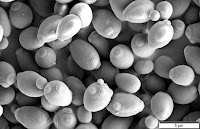
Saccharomyces yeast
By Mogana Das Murtey and
Patchamuthu Ramasamy
CC BY-SA 3.0
This episode: Prions in yeast can allow better adaptation to changing conditions!

Thanks to David Garcia for his contribution!

Download Episode (9.5 MB, 13.9 minutes)

Show notes:
Microbe of the episode: Hepatovirus F

News item

Takeaways
Prions can be deadly. They're misshapen proteins that cause a cascade of misfolding of similar proteins if they get into the nervous system, resulting in neurodegeneration in mammals. But in other organisms, they are not always so scary; some fungi use prions to regulate their behavior in varying conditions.

In this study, a prion allows yeast to switch between a fast-growing lifestyle with shorter reproductive lifespan that can be beneficial in conditions where nutrients are often plentiful, and a slower-growing but more enduring lifestyle that helps in more scarce conditions.

Journal Paper:
Garcia DM, Campbell EA, Jakobson CM, Tsuchiya M, Shaw EA, DiNardo AL, Kaeberlein M, Jarosz DF. 2021. A prion accelerates proliferation at the expense of lifespan. eLife 10:e60917.

Other interesting stories:

Post questions or comments here or email to bacteriofiles@gmail.com. Thanks for listening!

Subscribe: Apple Podcasts, Google Podcasts, Android, or RSS. Support the show at Patreon, or check out the show at Twitter or Facebook.
Monday, November 22, 2021

465 - Partners Produce Predator Prevention

Fungus cells with 
bacterial symbionts
By Büttner et al. 2021
PNAS 118:e2110669118
CC BY-NC-ND 4.0
This episode: Bacteria living inside soil fungus produce toxins that can protect their host from tiny predators!

Download Episode (7.7 MB, 11.2 minutes)

Show notes:
Microbe of the episode: Mycobacterium virus DLane

Takeaways
Soils have many different organisms cooperating and competing for resources. Some little worms called nematodes prey on fungi in the soil, while fungi may effectively defend themselves or strike back with toxins or traps that catch and kill the worms. On top of these interactions are other organisms that interact in various ways. In this study, bacteria living inside a kind of soil fungus produce toxins that defend the fungus against predatory nematodes.

Journal Paper:
Büttner H, Niehs SP, Vandelannoote K, Cseresnyés Z, Dose B, Richter I, Gerst R, Figge MT, Stinear TP, Pidot SJ, Hertweck C. 2021. Bacterial endosymbionts protect beneficial soil fungus from nematode attack. Proc Natl Acad Sci 118:e2110669118.

Other interesting stories:

Post questions or comments here or email to bacteriofiles@gmail.com. Thanks for listening!

Subscribe: Apple Podcasts, Google Podcasts, Android, or RSS. Support the show at Patreon, or check out the show at Twitter or Facebook.
Monday, November 8, 2021

464 - Prodding Pollen's Popping Process

Pollen
(fromWikipedia)
This episode: Certain nectar-dwelling bacteria can induce pollen to germinate to access their tasty proteins!

Download Episode (6.0 MB, 8.8 minutes)

Show notes:
Microbe of the episode: Clostridium oceanicum

News item

Takeaways
Nectar in flowers seems like it would be a great place for microbes to live, since it has so much sugar, but it's actually somewhat difficult to thrive solely in and on nectar. The carbon in sugar is only one essential element for life, and there's enough of it that it can be overwhelming to the osmotic balance of many microbes. Pollen could provide more nutrients in the form of protein and the nitrogen that comes with it, but it is difficult to penetrate its hard shell.

In this study, certain kinds of bacteria that live in nectar were able to access more pollen protein than other microbes by inducing pollen to germinate, growing out of its shell, or burst and release the protein directly. These microbes only benefited from pollen that were still alive and able to germinate, and not from those that had been disabled.

Journal Paper:
Christensen SM, Munkres I, Vannette RL. 2021. Nectar bacteria stimulate pollen germination and bursting to enhance microbial fitness. Curr Biol 31:4373-4380.e6.

Other interesting stories:

Post questions or comments here or email to bacteriofiles@gmail.com. Thanks for listening!

Subscribe: Apple Podcasts, Google Podcasts, Android, or RSS. Support the show at Patreon, or check out the show at Twitter or Facebook.

Monday, September 20, 2021

463 - Selectively Stimulating Cell Squatters

Bacteriophages
By Jancheva and Böttcher
2021, JACS 143:8344-8351
CC BY 4.0
This episode: Bacteria produce a compound that causes a phage lurking in the genome of a competing species to wake up and start killing that competitor!

Download Episode (8.2 MB, 12.0 minutes)

Show notes:
Microbe of the episode: Zaire ebolavirus

News item

Takeaways
Some bacteriophages infect and immediately destroy their hosts in a burst of new viruses, while others can be stealthier, integrating their genome into the genome of the host and remaining there quietly even over multiple generations of the bacteria. When something stresses the host, such as DNA damage, these integrated phages (prophages) become active and start producing new viruses, killing their host like the other kind does.

In this study, one kind of bacteria release a chemical that wakes up phages in a competitor species of bacteria. This is helpful for competition, but even more interesting is that out of the six prophages in the competitor species, the chemical wakes up only one of them. Such selective phage induction could be interesting to study.

Journal Paper:
Jancheva M, Böttcher T. 2021. A Metabolite of Pseudomonas Triggers Prophage-Selective Lysogenic to Lytic Conversion in Staphylococcus aureus. J Am Chem Soc 143:8344–8351.

Other interesting stories:

Post questions or comments here or email to bacteriofiles@gmail.com. Thanks for listening!

Subscribe: Apple Podcasts, Google Podcasts, Android, or RSS. Support the show at Patreon, or check out the show at Twitter or Facebook.

Monday, August 16, 2021

460 - Prokaryote Publicity Prevents Protist Processes

Emiliania huxleyi
By Alison R. Taylor
UNC Wilmington Microscopy
PLoS Biology, June 2011 Cover
CC BY 2.5
This episode: A bacterial communication signal makes algae stop growing, which helps them survive virus attacks!

Download Episode (5.3 MB, 7.7 minutes)

Show notes:
Microbe of the episode: Veillonella parvula

Takeaways
Many interesting interactions between microbes take place in the ocean. As single-celled organisms lacking complex sensory organs, many such interactions and communications are mediated by chemical signals. Some bacteria, for example, each produce small amounts of certain chemicals and release them into the environment. When the concentration of the chemical signal builds up to a certain point, the bacteria change their behavior to take advantage of their high numbers that must be present to produce so much of the signal. This process is called quorum sensing.

Some of these chemical signals can affect the behavior of organisms other than bacteria also. In this study, a common marine algal species was found to stop growing in response to a certain bacterial signal. This chemical inhibits an enzyme required for the algae to produce nucleotides to replicate their genomes. As a result, the algae are able to resist destruction by a virus that would otherwise decimate their populations.

Journal Paper:
Pollara SB, Becker JW, Nunn BL, Boiteau R, Repeta D, Mudge MC, Downing G, Chase D, Harvey EL, Whalen KE. 2021. Bacterial Quorum-Sensing Signal Arrests Phytoplankton Cell Division and Impacts Virus-Induced Mortality. mSphere 6:e00009-21.

Other interesting stories:

Post questions or comments here or email to bacteriofiles@gmail.com. Thanks for listening!

Subscribe: Apple Podcasts, Google Podcasts, Android, or RSS. Support the show at Patreon, or check out the show at Twitter or Facebook.

Monday, August 2, 2021

459 - Prokaryotes Provide Polyp Perserverance

Coral
By Brocken Inaglory
CC BY-SA 4.0
This episode: Transplanting microbes from some corals to others could help the corals survive high temperatures!

Download Episode (5.7 MB, 8.3 minutes)

Show notes:
Microbe of the episode: Streptomyces olivaceoviridis

News item

Takeaways
The ever-rising temperatures of our modern world are putting more and more stress on various ecosystems. This is true even on the ocean floor: record-high temperatures damage reefs by causing coral bleaching, in which corals lose their photosynthetic endosymbionts. If conditions do not improve, these corals eventually die.

Corals have microbial symbionts other than the phototrophs, also. We know from ourselves and from plants that microbes can have big effects on their hosts, so it seemed worth testing whether symbionts from more heat-resistant corals could transfer heat resistance to more vulnerable individuals. Recipients of this treatment did show enhanced heat resistance, but the microbial community composition did not always change after the treatment.

Journal Paper:
Doering T, Wall M, Putchim L, Rattanawongwan T, Schroeder R, Hentschel U, Roik A. 2021. Towards enhancing coral heat tolerance: a “microbiome transplantation” treatment using inoculations of homogenized coral tissues. Microbiome 9:102.

Other interesting stories:

Post questions or comments here or email to bacteriofiles@gmail.com. Thanks for listening!

Subscribe: Apple Podcasts, Google Podcasts, Android, or RSS. Support the show at Patreon, or check out the show at Twitter or Facebook.

Monday, July 19, 2021

458 - Slimy Cells Stop Sinking

Colonies of strains with
different floating strengths
By Kessler et al. 2021,
J Bacteriol 203(11):e00023-21
CC BY 4.0
This episode: Bacteria can resist the force of gravity in liquid culture by covering themselves with goopy sugar polymers like parachutes!

Download Episode (10.4 MB, 15.2 minutes)

Show notes:
Microbe of the episode: Brevicoryne brassicae virus

Takeaways
Put bacteria in a centrifuge, and most of the time you end up with a compact pellet of cells at the bottom of the tube, and mostly cell-free liquid above it. Bacteria do have ways to remain suspended in liquid, even without constant stirring or shaking of the container, but swimming, for example, consumes energy.

In this study, artificial selection allowed the discovery of bacteria that could resist centrifuging speeds up to 15000 times the force of gravity, remaining suspended in liquid instead of forming a pellet. Production of polysaccharide was important, but not sufficient; for the most resistance to sinking, bacteria had to attach the polysaccharide to their cell surface, to act as a sort of parachute.

Journal Paper:
Kessler NG, Caraballo Delgado DM, Shah NK, Dickinson JA, Moore SD. 2021. Exopolysaccharide Anchoring Creates an Extreme Resistance to Sedimentation. J Bacteriol 203(11):e00023-21.

Other interesting stories:

Post questions or comments here or email to bacteriofiles@gmail.com. Thanks for listening!

Subscribe: Apple Podcasts, Google Podcasts, Android, or RSS. Support the show at Patreon, or check out the show at Twitter or Facebook.

Monday, June 28, 2021

457 - Small Cell Studies: Superior Scoops

Plant microbiome
By KMG Dastogeera et al.
CC BY-SA 4.0
This episode: Newspapers report on scientific studies about microbiomes a fair amount, but certain kinds of studies are more likely than others to show up in the news!

Download Episode (5.7 MB, 8.3 minutes)

Show notes:
Microbe of the episode: Cafeteriavirus-dependent mavirus

Takeaways
Research into the human microbiome has generated a lot of interest, even among non-scientists. This is especially true since the beginning of the Human Microbiome Project in 2007. But sometimes things are lost in translation from published studies into general news.

This study is a survey of microbiome studies reported in six different news sources from three different countries, either general news or business news. General news did a better job reporting on different kinds of microbiome studies proportionally, but certain kinds of studies were reported on proportionally more or less frequently than they were published.

Journal Paper:
Prados-Bo A, Casino G. 2021. Microbiome research in general and business newspapers: How many microbiome articles are published and which study designs make the news the most? PLOS ONE 16:e0249835.

Other interesting stories:

Post questions or comments here or email to bacteriofiles@gmail.com. Thanks for listening!

Subscribe: Apple Podcasts, Google Podcasts, Android, or RSS. Support the show at Patreon, or check out the show at Twitter or Facebook.

Monday, May 31, 2021

454 - Hitchhiking Horticultural Helpers

Bacteria carrying spores
By Muok et al. 2021
ISME J, CC BY 4.0
This episode: Spores of some bacteria latch onto the tails of other bacteria and ride along as they move around in the soil!

Download Episode (5.5 MB, 8.0 minutes)

Show notes:
Microbe of the episode: Bohle iridovirus

News item

Takeaways
The soil is a complex environment, and microbes that live in soil need complex lifestyles to thrive. There are many examples of cooperation, competition, and other adaptations to highly varied situations.

In this study, bacteria that grow like filamentous fungi don't have the mechanisms to move autonomously, but their spores can hitch rides on other kinds of bacteria that swarm through the soil using their propeller-like tails called flagella to push themselves toward the plant roots they prefer to grow near.

Journal Paper:
Muok AR, Claessen D, Briegel A. 2021. Microbial hitchhiking: how Streptomyces spores are transported by motile soil bacteria. ISME J.

Other interesting stories:

Post questions or comments here or email to bacteriofiles@gmail.com. Thanks for listening!

Subscribe: Apple Podcasts, Google Podcasts, Android, or RSS. Support the show at Patreon, or check out the show at Twitter or Facebook.

Monday, May 24, 2021

453 - Phenazine Faciliates Phosphorus Feeding

Pseudomonas aeruginosa
By Y_tambe, CC BY-SA 3.0
This episode: Some bacteria produce antibiotics that can also help them gather more nutrients!

Download Episode (5.0 MB, 7.3 minutes)

Show notes:
Microbe of the episode: Diadromus pulchellus toursvirus

News item 1

Takeaways
Antibiotics have saved a lot of lives since they were discovered and used to treat many previously untreatable bacterial infections. But bacteria themselves have been making antibiotics much longer than we have, to help compete in their environment. However, sometimes these compounds are not produced in large enough concentrations to act as antibiotics, killing or inhibiting rival bacteria. Why waste energy on this sublethal production? Are there other functions these molecules can perform?

In this study, bacteria produce an antibiotic called phenazine that can damage cell components by redox reactions, transferring electrons. But it can also help liberate the essential nutrient phosphorus from being bound to insoluble particles, allowing the bacteria to grow better even in the absence of competitors.

Journal Paper:
McRose DL, Newman DK. 2021. Redox-active antibiotics enhance phosphorus bioavailability. Science 371:1033–1037.
Other interesting stories:

Post questions or comments here or email to bacteriofiles@gmail.com. Thanks for listening!

Subscribe: Apple Podcasts, Google Podcasts, Android, or RSS. Support the show at Patreon, or check out the show at Twitter or Facebook.