Showing posts with label bacteriophages. Show all posts

Monday, October 2, 2023

484 - Bacteriophages Boost Brains

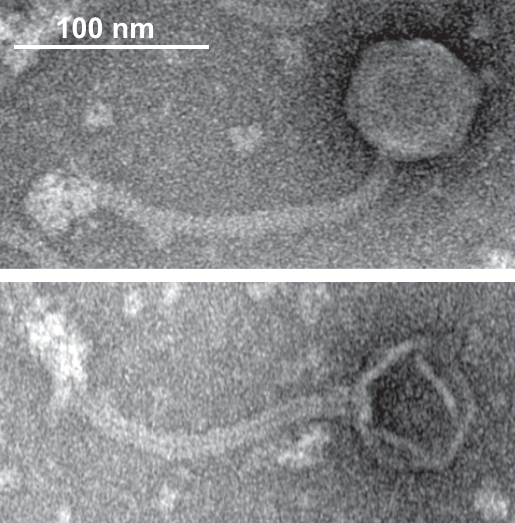
Lysogenic phage
By Rolf Lood et al.
BMC Microbiology
2008, 8:139
CC BY 2.5
This episode: Certain phages in the gut are linked with increases in performance on some cognitive tests!
Download Episode (7.5 MB, 10.9 minutes)

Show notes:
Microbe of the episode: Streptomyces bikiniensis

News item

Takeaways
Our gut microbiota includes a large number of viruses, mostly bacteriophages. These fall into two groups, the lytic kind that infects and reproduces itself immediately in a host, and the lysogenic kind that can integrate its genome into the host bacterial genome and remain dormant for long periods.

In this study, a higher proportion of lysogenic phages was correlated with increased performance on cognitive tests in multiple species. In humans, men showed a small increase in some tests and women in others. In mice and fruit flies, transplant or ingestion of phages was linked to increased memory performance.

Journal Paper:
Mayneris-Perxachs J, Castells-Nobau A, Arnoriaga-Rodríguez M, Garre-Olmo J, Puig J, Ramos R, Martínez-Hernández F, Burokas A, Coll C, Moreno-Navarrete JM, Zapata-Tona C, Pedraza S, Pérez-Brocal V, Ramió-Torrentà L, Ricart W, Moya A, Martínez-García M, Maldonado R, Fernández-Real J-M. 2022. Caudovirales bacteriophages are associated with improved executive function and memory in flies, mice, and humans. Cell Host Microbe 30:340-356.e8.


Post questions or comments here or email to bacteriofiles@gmail.com. Thanks for listening!

Subscribe: Apple Podcasts, Google Podcasts, Android, or RSS. Support the show at Patreon, or check out the show at Twitter or Facebook.

Monday, March 27, 2023

477 - Hijackers Hitchhike on Hyphal Highways

Phage stuck to non-host bacterium
By You et al, 2022,
ISMEJ 16:1275-1283
CC BY 4.0

This episode: Bacteriophages can hitch a ride on bacteria they don't infect to travel through soil on fungal filaments, potentially helping their carriers by infecting and killing their competitors!
Download Episode (7.1 MB, 10.3 minutes)

Show notes:
Microbe of the episode: Epinotia aporema granulovirus

News item

Takeaways
For tiny bacteria, partially dry soil can be like a vast system of caverns, with particles of soil separated by air-filled spaces much bigger than individual bacteria. Not all bacteria can swim through liquid, and those that can’t simply try to thrive as best they can wherever they may be. But for those that can swim, fungi and other filamentous organisms can form bridges between soil particles that motile bacteria can swim across, reaching new places.

In this study, phages were found to hitch a ride on bacteria they don’t normally infect, crossing fungus-like filaments to new places and infecting the bacteria they find there. The bacteria carrying them can also benefit from this interaction, since the phages help the carrier bacteria compete and establish a colony in the new location.

Journal Paper:
You X, Kallies R, Kühn I, Schmidt M, Harms H, Chatzinotas A, Wick LY. 2022. Phage co-transport with hyphal-riding bacteria fuels bacterial invasion in a water-unsaturated microbial model system. 5. ISME J 16:1275–1283.

Other interesting stories:

Post questions or comments here or email to bacteriofiles@gmail.com. Thanks for listening!

Subscribe: Apple Podcasts, Google Podcasts, Android, or RSS. Support the show at Patreon, or check out the show at Twitter or Facebook.

Monday, December 26, 2022

473 - Bacteriophage Bunks in Bacterial Barriers

Bacteriophages
By Jancheva and Böttcher,
2021, JACS 143:8344-8351
CC BY 4.0

 
This episode: A bacteriophage that overcomes the bacterial  CRISPR/Cas immune system by interrupting the CRISPR DNA with its own genome!
Download Episode (6.8 MB, 10 minutes)

Show notes:
Microbe of the episode: Wenzhou mammarenavirus
 
Takeaways
Bacteria have many ways to resist being exploited by bacteriophage viruses, including the adaptable CRISPR/Cas system that uses a piece of viral nucleic acid sequence to target and destroy incoming phages. But phages also have many ways to evade and disrupt bacterial defenses.

In this study, a phage is discovered that inserts its own genome into the CRISPR/Cas sequence in the bacterial genome, disrupting the bacterial defenses. To escape the defenses while it is doing this insertion, it carries genes for previously-unknown anti-CRISPR proteins. But inserting and removing a viral sequence from the bacterial genome is not always a clean procedure.

Journal Paper:
Varble A, Campisi E, Euler CW, Maguin P, Kozlova A, Fyodorova J, Rostøl JT, Fischetti VA, Marraffini LA. 2021. Prophage integration into CRISPR loci enables evasion of antiviral immunity in Streptococcus pyogenes. 12. Nat Microbiol 6:1516–1525.

Other interesting stories:

Post questions or comments here or email to bacteriofiles@gmail.com. Thanks for listening!

Subscribe: Apple Podcasts, Google Podcasts, Android, or RSS. Support the show at Patreon, or check out the show at Twitter or Facebook.

Monday, August 29, 2022

471 - Phage Fight Foils Fitness

Shigella phage A1-1
By Kortright et al., 2022.
AEM 2022, 88(e01514).
CC BY-4.0
This episode: A phage both kills bacterial pathogens and selects for reduced virulence!

Download Episode (6.3 MB, 9.9 minutes)

Show notes:
Microbe of the episode: Helminthosporium victoriae 145S virus
 
News item

Takeaways
Using bacteria-killing viruses to treat bacterial infections, or phage therapy, can be a good alternative to antibiotics in some situations when there are no effective antibiotics for a particular infection. But bacteria can evolve resistance to phages as well as antibiotics, often with little cost to their fitness.

In this study, a phage not only could treat an infection by attacking the bacteria, but the bacterial hosts that do evolve resistance to the phage do so by getting rid of certain structures that help them to cause more serious infection. Thus, therapy with this phage may both reduce the bacterial load and also make those remaining less virulent.

Journal Paper:
Kortright KE, Done RE, Chan BK, Souza V, Turner PE. 2022. Selection for Phage Resistance Reduces Virulence of Shigella flexneri. Appl Environ Microbiol 88:e01514-21.

Other interesting stories:

Post questions or comments here or email to bacteriofiles@gmail.com. Thanks for listening!

Subscribe: Apple Podcasts, Google Podcasts, Android, or RSS. Support the show at Patreon, or check out the show at Twitter or Facebook.
Monday, April 4, 2022

469 - Prophage Provides Partial Protection

Salmonella invading cells
This episode: A virus lurking in a bacterial genome protects its host population from infection with other phages, by killing off infected cells!

Download Episode (7.6 MB, 11.0 minutes)

Show notes:
Microbe of the episode: Olive latent ringspot virus

Takeaways
Many bacteriophages just go in and gobble up all their host's resources to make a bunch of new viruses right away. Others play a longer game, splicing into and lurking in the host's genome across multiple generations until conditions are right to multiply more rapidly. It is beneficial to these latter kind when their host is resistant to the fast-killing variety, but how can bacteria be resistant to some phages but not others?

In this study, one prophage (the phage genome integrated into the bacterial genome) carries a gene that does this in an interesting way. It prevents invading phages from replicating and kills the host cell so the infection can't spread, protecting the population (and all the other cells containing the prophage). It also contains an immunity element that allows the prophage to replicate itself without interference.

Journal Paper:
Owen SV, Wenner N, Dulberger CL, Rodwell EV, Bowers-Barnard A, Quinones-Olvera N, Rigden DJ, Rubin EJ, Garner EC, Baym M, Hinton JCD. 2021. Prophages encode phage-defense systems with cognate self-immunity. Cell Host Microbe 29:1620-1633.e8.

Other interesting stories:

Post questions or comments here or email to bacteriofiles@gmail.com. Thanks for listening!

Subscribe: Apple Podcasts, Google Podcasts, Android, or RSS. Support the show at Patreon, or check out the show at Twitter or Facebook.

Monday, September 20, 2021

463 - Selectively Stimulating Cell Squatters

Bacteriophages
By Jancheva and Böttcher
2021, JACS 143:8344-8351
CC BY 4.0
This episode: Bacteria produce a compound that causes a phage lurking in the genome of a competing species to wake up and start killing that competitor!

Download Episode (8.2 MB, 12.0 minutes)

Show notes:
Microbe of the episode: Zaire ebolavirus

News item

Takeaways
Some bacteriophages infect and immediately destroy their hosts in a burst of new viruses, while others can be stealthier, integrating their genome into the genome of the host and remaining there quietly even over multiple generations of the bacteria. When something stresses the host, such as DNA damage, these integrated phages (prophages) become active and start producing new viruses, killing their host like the other kind does.

In this study, one kind of bacteria release a chemical that wakes up phages in a competitor species of bacteria. This is helpful for competition, but even more interesting is that out of the six prophages in the competitor species, the chemical wakes up only one of them. Such selective phage induction could be interesting to study.

Journal Paper:
Jancheva M, Böttcher T. 2021. A Metabolite of Pseudomonas Triggers Prophage-Selective Lysogenic to Lytic Conversion in Staphylococcus aureus. J Am Chem Soc 143:8344–8351.

Other interesting stories:

Post questions or comments here or email to bacteriofiles@gmail.com. Thanks for listening!

Subscribe: Apple Podcasts, Google Podcasts, Android, or RSS. Support the show at Patreon, or check out the show at Twitter or Facebook.

Monday, September 6, 2021

461 - Ingrained Invader Inhibits Infectors

Lambda phage
By Hans-Wolfgang Ackermann
Swiss Institute of Bioinformatics
CC BY 4.0
This episode: Training a phage strain on bacteria can increase its ability to control those bacteria for much longer than an untrained phage!

Download Episode (5.7 MB, 8.3 minutes)

Show notes:
Microbe of the episode: Pepper yellow leaf curl Indonesia virus

News item

Takeaways
With resistance to antibiotics spreading more and more among deadly bacteria, finding alternatives to treat infections is becoming more important. One option is phage therapy, using viruses that infect bacteria to weaken or wipe out pathogens, but this can be tricky. Sometimes it takes too long to prepare an effective population of phage for treatment, and sometimes the target pathogen evolves resistance to the phage too quickly

In this study, a phage that was trained, or pre-evolved, to infect specific bacteria more effectively, was able to dominate the population consistently and prevent it from becoming fully resistant. For comparison, against an untrained strain of the same phage, the bacteria developed almost complete resistance after several days.

Journal Paper:
Borin JM, Avrani S, Barrick JE, Petrie KL, Meyer JR. 2021. Coevolutionary phage training leads to greater bacterial suppression and delays the evolution of phage resistance. Proc Natl Acad Sci 118.

Other interesting stories:

Post questions or comments here or email to bacteriofiles@gmail.com. Thanks for listening!

Subscribe: Apple Podcasts, Google Podcasts, Android, or RSS. Support the show at Patreon, or check out the show at Twitter or Facebook.

Monday, January 18, 2021

444 - Strange Sequence Stops Cell Subjugation

T4 Bacteriophage
By Victoramuse,
CC BY-SA 4.0
This episode: An interesting bacterial genetic element protects against viruses in a unique way!

Download Episode (7.1 MB, 10.3 minutes)

Show notes:
Microbe of the episode: Mongoose associated gemykibivirus 1


Takeaways
Even single-celled, microscopic organisms such as bacteria have to deal with deadly viruses infecting them. And while they don't have an immune system with antibodies and macrophages like we do, they still have defenses against infection, mostly based on sensing and destroying viral genomes. Restriction enzymes cut viral genomes at specific places, and CRISPR/Cas targets and destroys specific viral sequences. Knowing this, when microbiologists contemplate a strange genetic element of unknown function in bacteria, it's worth considering that it may be relevant to defense against phages.

The strange element in this case is retrons: a special reverse transcriptase enzyme takes a short non-coding RNA transcript and transcribes it into DNA, then links the RNA and DNA sequences together. These retrons are found in a variety of forms in a variety of microbes, and their function has been unknown up till now. In this study, one specific retron was found to defend bacteria against a number of phages. By comparing viruses, they discovered that this retron functions by sensing viruses' attempts to defeat another bacterial defense, a sort of second level of defenses. How common such a system is, what variants may exist, and how we may be able to use it for research or biotech purposes remain to be determined.

Journal Paper:
>Millman A, Bernheim A, Stokar-Avihail A, Fedorenko T, Voichek M, Leavitt A, Oppenheimer-Shaanan Y, Sorek R. 2020. Bacterial Retrons Function In Anti-Phage Defense. Cell 183:1551-1561.e12.

Other interesting stories:

Post questions or comments here or email to bacteriofiles@gmail.com. Thanks for listening!

Subscribe: Apple Podcasts, Google Podcasts, Android, or RSS. Support the show at Patreon, or check out the show at Twitter or Facebook.

Monday, September 28, 2020

434 - Killer Carries Compact Cas

T4 bacteriophage
By Victoramuse
CC BY-SA 4.0
This episode: Large phage discovered that contains a compact version of the CRISPR/Cas defense/gene editing system!

Download Episode (5.9 MB, 8.6 minutes)

Show notes:
Microbe of the episode: Stenotrophomonas virus IME13

News item

Takeaways
CRISPR/Cas systems have made a lot of things in gene editing much easier in certain organisms. It's almost as easy as just getting the cells to produce the Cas protein and putting in an RNA sequence to tell it where to go! But in some cases, these requirements are too much to work well.

In this study, a more compact version of CRISPR/Cas was discovered in large bacteriophages. These systems help the viruses compete with other viruses and defend against host defenses sometimes. The Cas protein is half the size of the standard Cas most used in gene editing, and it has fewer other requirements to function in new cells, so it could be better in versatility and potential in applications with strict space constraints.

Journal Paper:
Pausch P, Al-Shayeb B, Bisom-Rapp E, Tsuchida CA, Li Z, Cress BF, Knott GJ, Jacobsen SE, Banfield JF, Doudna JA. 2020. CRISPR-CasΦ from huge phages is a hypercompact genome editor. Science 369:333–337.

Other interesting stories:

Post questions or comments here or email to bacteriofiles@gmail.com. Thanks for listening!

Subscribe: Apple Podcasts, Google Podcasts, Android, or RSS. Support the show at Patreon, or check out the show at Twitter or Facebook.

Monday, September 21, 2020

433 - Probiotic Promotes Pathogen Peacefulness

E. coli in lumen of organoid
From Pradhan and Weiss, 2020
mBio 11(4):e01470-20
CC BY 4.0

This episode: A probiotic can protect intestine-like cell growths from destruction by pathogens, but it can also be infected by a virus that makes it more harmful to intestinal cells!

Download Episode (6.9 MB, 10.1 minutes)

Show notes:
Microbe of the episode: Euphorbia yellow mosaic virus

News item

Takeaways
There are many strains of Escherichia coli. Some are pathogenic, in the gut or the urinary tract, and a subset of those are very dangerous, such as the enterohemorrhagic O157:H7 strain. Many others are commensals, living peacefully as part of our gut community. And some strains can be beneficial to the host, protecting from and reducing the severity of disease. One such strain is called E. coli Nissle.

This study used an advanced model of human intestines called organoids, where stem cells are induced to develop into hollow spheres of intestinal epithelium in which all cell types of a normal intestinal wall are represented. E. coli pathogens typically destroy these organoids and escape from inside, but Nissle was able to prevent this destruction and enable coexistence between the pathogen and the host cells. Nissle suffered for this protection though; O157:H7 carries a toxin-encoding phage that can infect and kill susceptible E. coli strains. Those Nissle cells that survived this infection could resist the phage, but were not as beneficial to the organoids due to the toxin they now produced.

Journal Paper:
Pradhan S, Weiss AA. 2020. Probiotic Properties of Escherichia coli Nissle in Human Intestinal Organoids. mBio 11(4):e01470-20.

Other interesting stories:

Post questions or comments here or email to bacteriofiles@gmail.com. Thanks for listening!

Subscribe: Apple Podcasts, Google Podcasts, Android, or RSS. Support the show at Patreon, or check out the show at Twitter or Facebook.

Monday, June 22, 2020

425 - Paired Predators Prevent Pathogen Persistence

Haloed plaques, Bdellovibrio,
and bacteriophage
By Hobley et al. 2020,
J Bacteriol 202(6), CC BY 4.0
This episode: A bacteriophage and bacterial predator can wipe out a population of bacteria that could develop resistance to each individually!

Thanks to Laura Hobley, J. Kimberley Summers, and Jan-Ulrich Kreft for their contributions!

Also a note: I will be taking a short break from podcasts while I rebuild my collection of awesome microbiology stories to talk about.


Download Episode (6.8 MB, 9.9 minutes)

Show notes:
Microbe of the episode: Blackbird associated gemycircularvirus 1

Takeaways
Bacteriophages and bacterial predators that prey on other bacteria are both very good at killing large numbers of bacteria. But bacteria as a whole are also very good at surviving being killed in large numbers; there are almost always a few that have the right genes to overcome whatever is doing the killing. This is what makes the threat of antibiotic resistance so scary, and why phage therapy is both very promising and very limited.

In this study, however, a combination of phages and the bacterial predator Bdellovibrio bacteriovorans is able to completely eradicate a population of bacteria, or at least reduce their numbers below a detectable level. A mathematical model based on these data predicts that despite the two killers working independently, they can effectively eliminate all the individual prey organisms that would otherwise be able to resist killing by either one alone.

Journal Paper:
Hobley L, Summers JK, Till R, Milner DS, Atterbury RJ, Stroud A, Capeness MJ, Gray S, Leidenroth A, Lambert C, Connerton I, Twycross J, Baker M, Tyson J, Kreft J-U, Sockett RE. 2020. Dual Predation by Bacteriophage and Bdellovibrio bacteriovorus Can Eradicate Escherichia coli Prey in Situations where Single Predation Cannot. J Bacteriol 202.

Other interesting stories:

Post questions or comments here or email to bacteriofiles@gmail.com. Thanks for listening!

Subscribe: Apple Podcasts, Google Podcasts, Android, or RSS. Support the show at Patreon, or check out the show at Twitter or Facebook.

Monday, May 25, 2020

421 - Nucleocapsids Navigate Nano Nuggets

Gold nanorods bound to phage
Used with permission
This episode: Using phages to target gold nanoparticles to infecting bacteria, then using light to heat the nanoparticles just enough to kill the bacteria!

Thanks to Huan Peng and Raymond Borg for contributing!


Download Episode (10.6 MB, 15.4 minutes)

Show notes:
Microbe of the episode: Pantoea agglomerans

News item

Takeaways
Viruses that infect bacteria, bacteriophages, are often very good at overcoming bacterial defenses and killing them. This raises the possibility, and many times actuality, of using phages to treat bacterial infections that are no longer treatable with antibiotics. But bacteria can evolve resistances to viruses as well as drugs, and using multiplying, evolving entities as treatments in people raises questions about the safety and consistency of the treatment.

This study circumvents these questions by using phages for delivery and targeting of bacteria rather than the therapeutic agent itself. The actual treatment is done with tiny rods of gold, gold nanorods, bound to the phage surface. When a certain wavelength of light hits these nanorods, they vibrate enough to generate enough heat in their immediate surroundings to render nearby bacteria nonviable. Thus the infection is treated in a very localized, targeted way that doesn't leave any active bacteria or phages behind. The authors have plans to study this approach as a topical treatment of wounds.

Journal Paper:
Peng H, Borg RE, Dow LP, Pruitt BL, Chen IA. 2020. Controlled phage therapy by photothermal ablation of specific bacterial species using gold nanorods targeted by chimeric phages. Proc Natl Acad Sci 117:1951–1961.

Other interesting stories:

Post questions or comments here or email to bacteriofiles@gmail.com. Thanks for listening!

Subscribe: Apple Podcasts, Google Podcasts, Android, or RSS. Support the show at Patreon, or check out the show at Twitter or Facebook.

Monday, March 9, 2020

BacterioFiles 417 - Bacteriophage Blocks Bacterial Bouncers

Pseudomonas aeruginosa
By Y_tambe, CC BY-SA 3.0
This episode: A phage defends its genome against bacterial host defenses by building a wall to keep them out!


Download Episode (7.0 MB, 10.2 minutes)

Show notes:
Microbe of the episode: Myroides odoratus and M. odoratimimus

News item

Takeaways
Parasites and their hosts are constantly in arms races with each other, each thriving best when it acquires new and more effective methods of attack, defenses, defenses against defenses, and so on. Bacterial defenses against viruses that infect them mostly involve cutting up viral genomes, either by the indiscriminate specific-cutting restriction enzymes, or by adaptive, sequence-sensing CRISPR/Cas systems.

Bacteriophages have proteins that can defend against the CRISPR/Cas system, but they mostly require the sacrifice of multiple failed infections before the proteins build up enough to defeat the defense. In this study, a phage is discovered that can immediately defend against all DNA-cutting systems, by constructing a nucleus-like protective compartment inside the host.

Journal Paper:
Mendoza SD, Nieweglowska ES, Govindarajan S, Leon LM, Berry JD, Tiwari A, Chaikeeratisak V, Pogliano J, Agard DA, Bondy-Denomy J. 2020. A bacteriophage nucleus-like compartment shields DNA from CRISPR nucleases. Nature 577:244–248.

Other interesting stories:

Post questions or comments here or email to bacteriofiles@gmail.com. Thanks for listening!

Subscribe: Apple Podcasts, Google Podcasts, Android, or RSS. Support the show at Patreon, or check out the show at Twitter or Facebook.

Monday, November 25, 2019

BacterioFiles 404 - Phages Force Food Finding

Synechococcus cyanobacteria
This episode: Another climate-related story: Cyanobacteria infected by viruses continue taking up nutrients from their environment, using it to make more viruses than would otherwise be possible!

Download Episode (6.3 MB, 9.2 minutes)

Show notes:
Microbe of the episode: Microcystis virus Ma-LMM01

News item

Takeaways
Though global warming is a global problem, accurate models for predicting where things are headed need to incorporate the activity of even the smallest organisms, if they're numerous enough. Photosynthesis and other activities of microbes in the oceans are a big sink for carbon, but cycles of other nutrients and also viruses can affect the carbon cycle.

In this study, phages infecting photosynthetic ocean bacteria were able to continue their host's uptake of nitrogen from the environment even after mostly shutting down the host's own protein production and growth. This has implications for how viruses affect carbon cycling by cyanobacteria and how quickly populations of these bacteria may grow or die off.

Journal Paper:
Waldbauer JR, Coleman ML, Rizzo AI, Campbell KL, Lotus J, Zhang L. 2019. Nitrogen sourcing during viral infection of marine cyanobacteria. Proc Natl Acad Sci 116:15590–15595.

Other interesting stories:

Post questions or comments here or email to bacteriofiles@gmail.com. Thanks for listening!

Subscribe: Apple Podcasts, Google Podcasts, Android, or RSS. Support the show at Patreon, or check out the show at Twitter or Facebook.

Monday, July 8, 2019

BacterioFiles 390 - Friendly Phages Find Foes

E. coli bacteria
This episode: Bacteria carry deadly phages and use them against rival strains!

Download Episode (9.4 MB, 10.2 minutes)

Show notes:
Microbe of the episode: Bifidobacterium bifidum

News item

Takeaways
Bacteria such as Escherichia coli live in environments such as the gut with many other types of microbes, and often develop communities of microbes cooperating and/or competing with each other for resources. But in order to cooperate or compete, bacteria must first be able to identify and discriminate between themselves and others. Sometimes microbes do this by exchanging membrane molecules, or secreting chemical signals that only partners can detect, or transferring plasmids or producing antimicrobial compounds that kill competitors.

In the current study, scientists discovered a strain of E. coli that carries around phages that help them distinguish other strains and compete with them. When this strain encounters another, the phages it carries attack and destroy cells of the other strain, while leaving the carrier strain mostly unharmed. This strategy is not without cost, though; the viral proteins take resources to produce, and when there's no competing strains around, the virus can attack its carrier to some extent.

Journal Paper:
Song S, Guo Y, Kim J-S, Wang X, Wood TK. 2019. Phages Mediate Bacterial Self-Recognition. Cell Reports 27:737-749.e4.

Other interesting stories:

Post questions or comments here or email to bacteriofiles@gmail.com. Thanks for listening!

Subscribe: Apple Podcasts, RSS, Google Play. Support the show at Patreon, or check out the show at Twitter or Facebook.

Monday, March 11, 2019

BacterioFiles 377 - Distributed Defense-Defeating Devices

This episode: Newly discovered CRISPR-inhibiting genes are found in many different bacterial groups!

Download Episode (8.0 MB, 8.8 minutes)

Show notes:
Microbe of the episode: Borrelia mazzottii

News item

Takeaways
The discovery of the microbial immune system, CRISPR-Cas, changed many things about the way we think of microbial ecology and interactions with microbe-infecting viruses. The CRISPR-Cas system can learn to detect new threats by capturing bits of their genetic sequences and using these to target the Cas proteins to chop up any such sequences that make it into the cytoplasm. This can greatly increase microbial survival in certain ecosystems in which viruses regularly kill a large percentage of the microbial population.

To overcome this defense, a virus has to adapt, either by acquiring mutations that change its sequence, thus escaping detection, or by acquiring anti-CRISPR proteins that shut down the microbial defense directly. These possibilities make the complex ecology even more interesting.

In this study, scientists develop a clever method for screening for new anti-CRISPR genes, and go searching for them in samples from various places (soil, animal guts, human gut). They find several new examples, which turn out to be found in many different kinds of species in many different environments.

Journal Paper:
Uribe RV, Helm E van der, Misiakou M-A, Lee S-W, Kol S, Sommer MOA. 2019. Discovery and Characterization of Cas9 Inhibitors Disseminated across Seven Bacterial Phyla. Cell Host & Microbe 25:233-241.e5.

Other interesting stories:

Post questions or comments here or email to bacteriofiles@gmail.com. Thanks for listening!

Subscribe: Apple Podcasts, RSS, Google Play. Support the show at Patreon, or check out the show at Twitter or Facebook.

Monday, January 28, 2019

BacterioFiles 371 - Cell Stalker Senses Signals

Vibrio cholerae
This episode: Phages eavesdrop on bacterial communications to attack at the perfect moment!

Thanks to Justin Silpe and Dr. Bonnie Bassler for their contributions!

Download Episode (11.1 MB, 12.2 minutes)

Show notes:
Microbe of the episode: Artichoke Aegean ringspot virus

News item

Takeaways
Even organisms as small as bacteria can, and often do, communicate with each other through a process called quorum sensing, in which each cell releases a small amount of a certain chemical into their surroundings. When the population is large enough that the concentration of this chemical builds up to a certain level, the cells in the population change their behavior. The specifics of this change depend on the species and the situation.

But since this chemical signal is released into the environment, anything around that can sense it can listen in on the communications of a bacterial population. In this study, Justin Silpe and Dr. Bonnie Bassler find a type of virus that uses such a chemical communication as a signal to come out of stasis and hijack a whole population of bacteria at once!

Journal Paper:
Silpe JE, Bassler BL. 2019. A Host-Produced Quorum-Sensing Autoinducer Controls a Phage Lysis-Lysogeny Decision. Cell 176:268-280.E13.

Other interesting stories:

Post questions or comments here or email to bacteriofiles@gmail.com. Thanks for listening!

Subscribe: Apple Podcasts, RSS, Google Play. Support the show at Patreon, or check out the show at Twitter or Facebook.

Monday, September 3, 2018

BacterioFiles 354 - Prokaryote Protection Promotes Protein Passing

Pectobacterium cells
By: The James Hutton Institute
This episode: The bacterial immune system, CRISPR-Cas, can enhance gene transfer via transduction (phages carrying bacteria DNA) despite preventing it via conjugation!

Thanks to Bridget Watson for her contribution!

Download Episode (14.9 MB, 16.3 minutes)

Show notes:
Microbe of the episode: Human polyomavirus 8

Journal Paper:
Watson BNJ, Staals RHJ, Fineran PC. 2018. CRISPR-Cas-Mediated Phage Resistance Enhances Horizontal Gene Transfer by Transduction. mBio 9:e02406-17.

Other interesting stories:

Post questions or comments here or email to bacteriofiles@gmail.com. Thanks for listening!

Subscribe: Apple Podcasts, RSS, Google Play. Support the show at Patreon, or check out the show at Twitter or Facebook.

Episode outline:

Monday, June 25, 2018

BacterioFiles 344 - Bacteriophages Bypass Body Barriers

Cell culture setup
Nguyen et al, 2017,
mBio 8:e01874-17
This episode: Phages may be passing through the barriers in our body all the time!

Thanks to Dr. Jeremy Barr for his contribution!
Download Episode (13.2 MB, 14.5 minutes)

Show notes:
Microbe of the episode: Rhodobacter virus RcCronus

News item

Journal Paper:
Nguyen S, Baker K, Padman BS, Patwa R, Dunstan RA, Weston TA, Schlosser K, Bailey B, Lithgow T, Lazarou M, Luque A, Rohwer F, Blumberg RS, Barr JJ. 2017. Bacteriophage Transcytosis Provides a Mechanism To Cross Epithelial Cell Layers. mBio 8:e01874-17.

Other interesting stories:
  • Yeast species uses same codon for two different amino acids (paper)

  • Post questions or comments here or email to bacteriofiles@gmail.com. Thanks for listening!

    Subscribe: Apple Podcasts, RSS, Google Play. Support the show at Patreon, or check out the show at Twitter or Facebook.

    Episode outline:

    Monday, April 16, 2018

    BacterioFiles 336 - Phages Fortify Friendly Fighters

    Neutrophil captures Pseudomonas
    aeruginosa
    cells
    By Paulo Henrique Orlandi Mourao,
    CC BY-SA 3.0
    This episode: Phage therapy can work very well when combined with an effective immune response from the host!

    Download Episode (12.9 MB, 14.1 minutes)

    Show notes:
    Microbe of the episode: Gammapapillomavirus 8

    News item about "nightmare bacteria"

    Journal Paper:
    Roach DR, Leung CY, Henry M, Morello E, Singh D, Di Santo JP, Weitz JS, Debarbieux L. 2017. Synergy between the Host Immune System and Bacteriophage Is Essential for Successful Phage Therapy against an Acute Respiratory Pathogen. Cell Host Microbe 22:38-47.e4.

    Other interesting stories:
  • Bacteria make antibacterial silver nanoparticles (paper)
  • Bacteria produce chemical that could enhance effectiveness of penicillin
  • Engineering yeast to produce valuable complex chemicals
  • Specific types of gut microbes affect cancer treatment effectiveness
  • Microbe-produced enzymes could help clean oil spills

  • Post questions or comments here or email to bacteriofiles@gmail.com. Thanks for listening!

    Subscribe: Apple Podcasts, RSS, Google Play. Support the show at Patreon, or check out the show at Twitter or Facebook.

    Episode outline: